
The Library 010: Deep Work
What I learned about focus from a book I probably should have read sooner

The modern workplace has been setup to promote efficiency, collaboration and support your caffeine intake. Yet with all of our open concept office spaces and communication channels… the modern day knowledge worker is running on a mental hamster wheel.
We feel like we are doing so much, yet we are often not producing our life’s best work.
That’s where Cal Newport steps into the picture. Cal’s book, Deep Work, is a book I wish I would’ve read sooner.
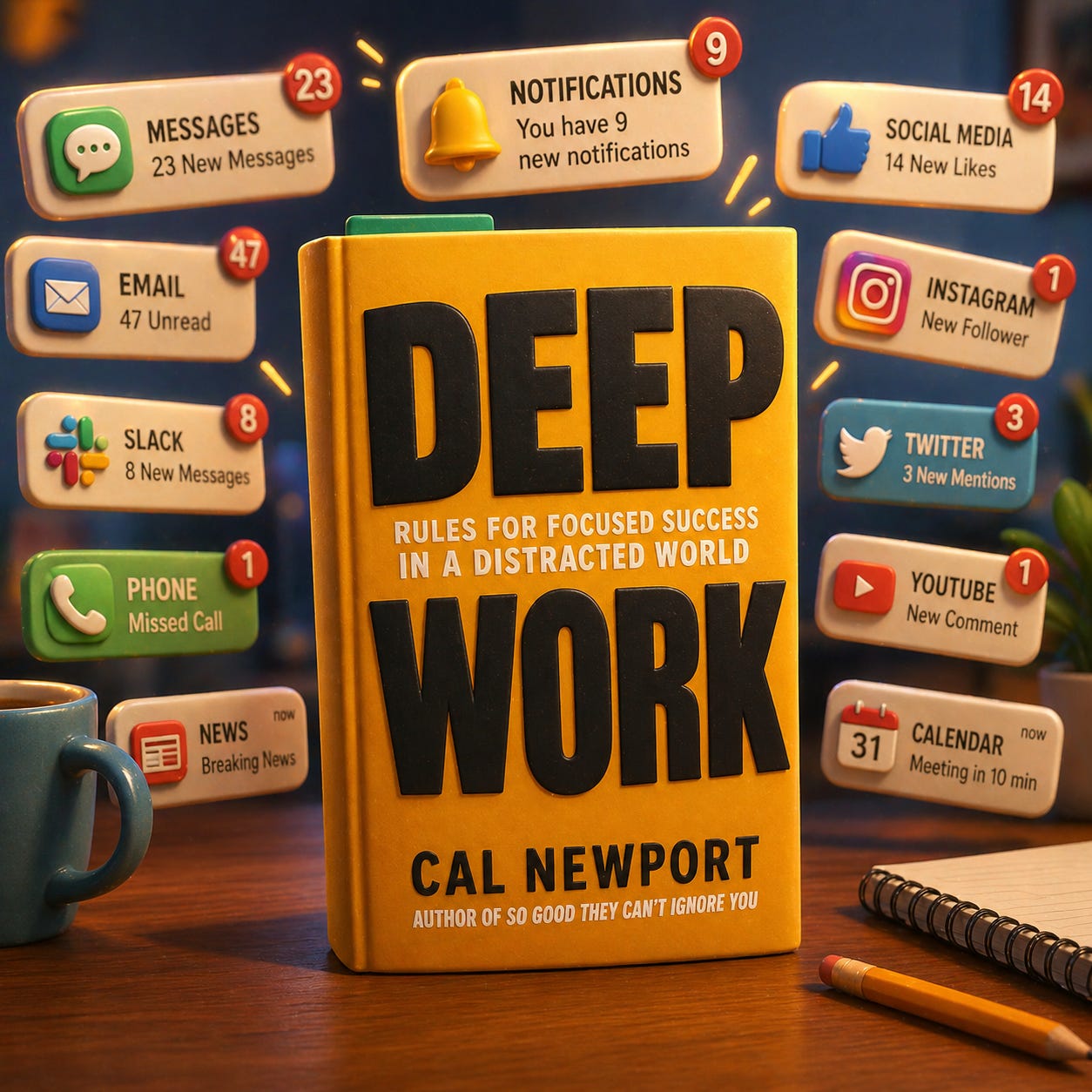
Cal makes the case that we’ve substituted actual productivity for perceived busyness… and I couldn’t agree more.
To start let’s paint a picture of what has changed in the way we work over the last 100 years.
In the early 1900s, 9 out of 10 Americans made their living through some type of physical work. Simply put: they made stuff with their hands. They got paid based on what they produced. End of story.
Fast forward to today and 3 out of 4 American workers make their living doing some type of cognitive work, or as Peter Drucker coined - knowledge work. Think Software Designer, Marketing Strategist or Pastor. Most of their work happens inside their mind.
Now to be clear, the term “knowledge worker” doesn’t imply that tradesmen or those who work in manual labor don’t use a tremendous amount of brain power. They do. That’s not the point Cal is trying to make.
Though the nature of work has drastically changed, the way we measure productivity hasn’t fully caught up. 100 years ago… you’d know clearly how to measure one day’s work. You produced 100 tomatoes, you built 3 fences, or perhaps you delivered a neighborhood’s worth of milk. Simple to measure.
Through the 1900s, we’ve worked tirelessly to become more efficient at the “stuff” we can make, but as we’ve transitioned from working with our hands to our heads… we seem to be trying to apply the same measurement rules.
The problem? Knowledge work can be hard to measure.
Knowledge work requires deep work. That sometimes looks like typing away at a computer, but deep work can also involve going for a walk to think or brainstorming ideas across a whiteboard.
Cal defines deep work as “professional activities performed in a state of distraction-free concentration that push your cognitive capabilities to their limit.”
He also defines shallow work as “non-cognitively demanding, logistical-style tasks, often performed while distracted.”
In Cal’s book, he details one of the many issues that get in the way of entering into deep work: Notifications & Office Expectations.
It always seems to be the moment you’ve gotten into “flow state” and are doing deep work, you get the notification ding about a new email that just arrived from your boss. You click into it and begin to craft a response when a co-worker shows up with a question about something they are trying to solve for. Your mindset shifts focus to trying to help them figure it out. Moments after they walk away your phone begins to ring and someone who reports to you is in a “crisis” of sorts that they need your support with. Next thing you know, you never got back to your boss who likes timely email responses.
This is a short, but common example of what it can feel like to work in the modern office. We do a lot but we rarely go deep.
The problem is that shallow work rarely produces meaningful progress.
Cal argues that deep work is where we produce anything of meaning or value that can truly impact our organization, customers or fellow staff.
Doesn’t that sound rather magical? The idea that you could make something or produce something that changes the world. It won’t happen in the realm of shallow work.
So what do you do if you’re tired of the mental hamster wheel that you call your job? What do you do if you’re tired of getting home feeling like you ran mental sprints all day with little to show for it?
You commit to doing deep work… where you can.
The reality that Cal shares is that not all working environments or job descriptions lend themselves to doing deep work. But this reality doesn’t leave you stuck.
Whether you work in an office space or work as an entrepreneur… you can begin to build rhythms that support your deep work life.
I’ll let Cal share with you his best practices in his book but to name a few:
Block your most cognitively engaging hours off on your calendar
Speak to your boss about expectations around notification response time
Know that some deep work is better than no deep work. If it’s one hour or four, it’s worth investing in
Create a deep work space or go find one so you can lock in
The time is now to take back what has been lost: your attention.
Your life’s greatest work may be waiting on your willingness to go deep.
The Library Reflection
One Question:
Have you confused being busy with being productive?
One Action:
Block off one uninterrupted hour this week for your most important work.
One Quote:
“Your world is the sum of what you pay attention to.” — Cal Newport